A significant portion of machine failures in industry are caused by incorrect connector selection. An unsuitable or low-quality connector leads to unplanned downtime, occupational safety risks and high costs. This guide discusses the technical criteria and considerations for correct selection.
1. Types of Industrial Connectors
Heavy-Duty Connectors
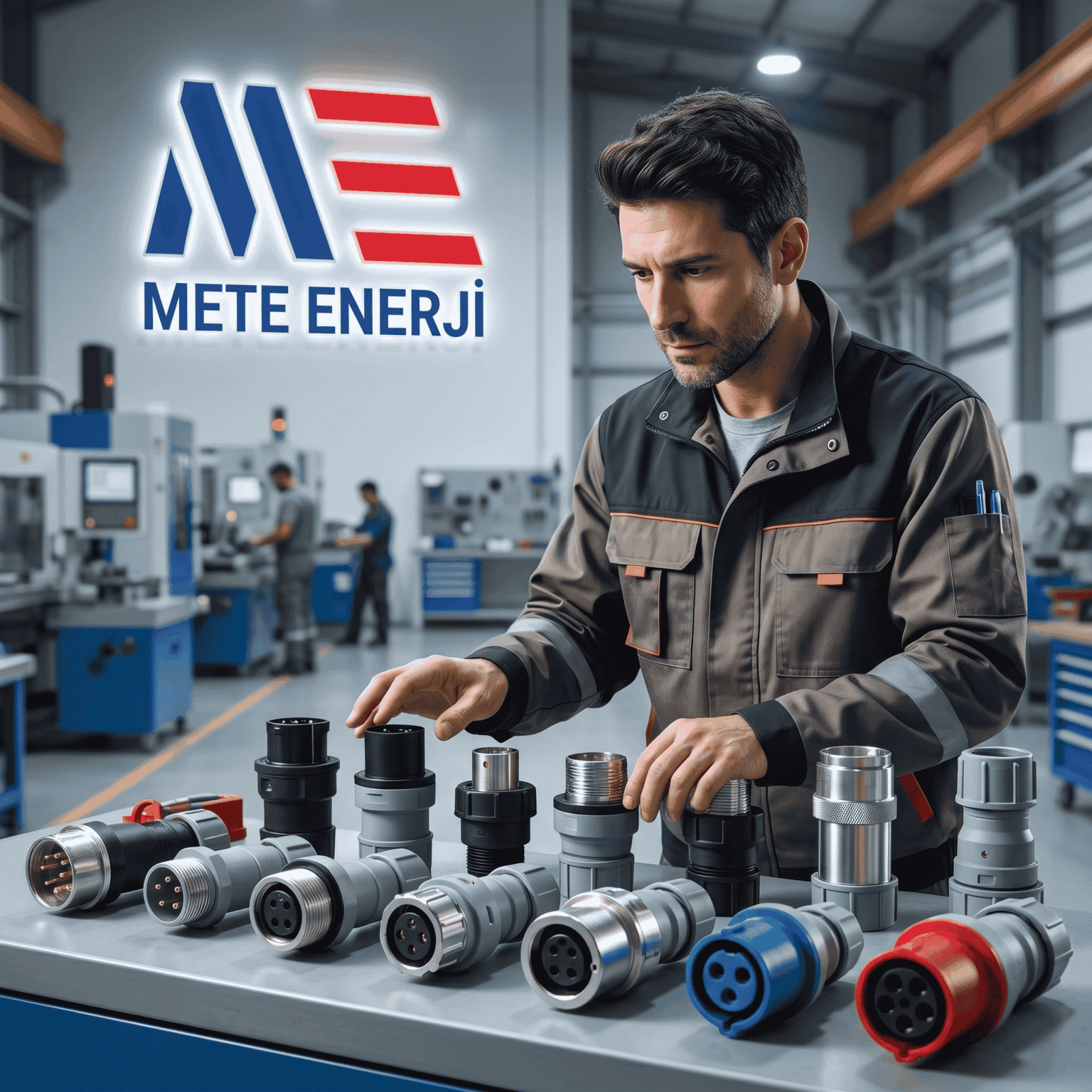
Heavy-duty connectors are designed to safely provide signal, power, data and pneumatic transmission in the harshest industrial conditions. Offering superior resistance to water, lubricants, coolants, dirt and high mechanical stress, these products are preferred in machinery manufacturing, automation lines and heavy industrial applications.
Key Features
Flexible configuration with modular contact spacers
UL, CSA, CE international product approvals
Power, signal and data transfer in a single port
Sealing up to IP68 degree of protection
CEE Norm Plug and Socket
Industrial plugs and sockets manufactured in accordance with IEC 60309 (CEE 17) are widely used in factories, workshops, construction sites and industrial plants. They are designed to safely carry much higher voltage and current values compared to standard household products.
Technical Specifications
Rated current 16 A - 32 A - 63 A - 125 A
Voltage 110 V, 220 V, 380 V, 415 V
Protection class: IP44 - IP67
Voltage and ampere identification with color coded system
Polyamide housing, brass conductive contact
Multi-contact and Combined Systems
Multi-contact plug and socket systems are used for applications where standard solutions are insufficient. With 4, 5, 6, 10, 16 and 24 contact options, they offer solutions for small workshops to large industrial plants. Combined systems provide power and control signals from a single connection point, providing advantages in terms of cable layout and ease of maintenance.
2. Connector Selection Criteria
2.1 IP Protection Class
The IP (Ingress Protection) code defines the level of resistance of a connector against solid objects and liquids according to the IEC 60529 standard. It is the most critical technical criterion for industrial product selection. The first digit in the code stands for dust protection, the second digit for liquid resistance.
IP Class
Dust Protection
Water Protection
Typical Application
IP44
Partial protection
Splash water resistant
Closed workshops
IP55
Dust resistant
Water jet from all directions
Production lines
IP65
Fully dustproof
Low pressure water jet
Outdoor equipment
IP67
Fully dustproof
Temporary underwater (1 m / 30 min)
Food and chemical plants
IP68
Fully dustproof
Permanently underwater
Maritime, mining
IP69K
Fully dustproof
High pressure + hot water
Food/beverage, agricultural machinery
Questions to answer when determining the IP class:
Will the connector be used indoors or outdoors?
Is there dust, dirt or metallic particles in the environment?
Is there water contact, condensation or washing?
Is there a possibility of exposure to chemicals or lubricants?
2.2 Current and Voltage Values
The current and voltage ratings that the connector must carry are the primary engineering criteria for selection. A connector below the rated value can cause overheating, arcing and short circuit.
Yük akımı hesaplanırken %20–30 güvenlik payı bırakılmalıdır
Continuous load and instantaneous peak load should be evaluated separately
Three-phase (380 V) and single-phase (220 V) systems require different pin configuration
The frequency value (50 Hz / 60 Hz) must match the product labeling
2.3 Environment Conditions
The operating environment directly affects the IP rating, housing material and mounting type. Chemical plants, food production lines and outdoor applications may have requirements beyond standard IP65 protection.
In case of chemical contact, body material resistant to acids and bases should be preferred
IP69K (high pressure hot water washdown) may be mandatory in the food and pharmaceutical sector
If vibration and impact are present, heavy-duty connectors with locking mechanisms should be selected
ATEX certified Ex-proof products should be used in flammable and explosive environments
The operating temperature range must be compared with the product technical values
3. Common Mistakes
Use of Non-Standard Products
The use of household plugs and sockets in industrial environments is one of the most common and costly mistakes. These products deform in a short time in the face of moisture, dust, impact and high current loads, leading to unplanned downtime.
Reflection of the non-standard connector in the production process:
Unplanned machine downtime and loss of production
Risk of arcing and short circuit
Increased preventive maintenance cost
Occupational safety obligations and possible audit findings
Wrong IP Class Selection
It is a common misconception in practice that the IP protection rating is only waterproof. The IP code covers both solid body and liquid resistance; both aspects must be considered.
Using IP20 or IP44 rated product outdoors
Considering IP44 sufficient in humid environment
IP65 for lines requiring flushing - IP67 or IP69K may be required
Prefer standard connector in explosive environment
Current and Voltage Mismatch
Connectors that operate continuously at or above the nominal value limit cause overheating and contact erosion. A connector specified without load calculation will either be oversized and create unnecessary cost, or under capacity and produce premature failure.
Ignoring Ambient Conditions
Selection based on current and IP rating alone is not sufficient. Chemical compatibility, operating temperature, mechanical vibration and maintenance period should also be included in the selection process.


 Turkish
  English